


Monster Truck Soccer: Positioning, Ball Control and Smarter Recoveries
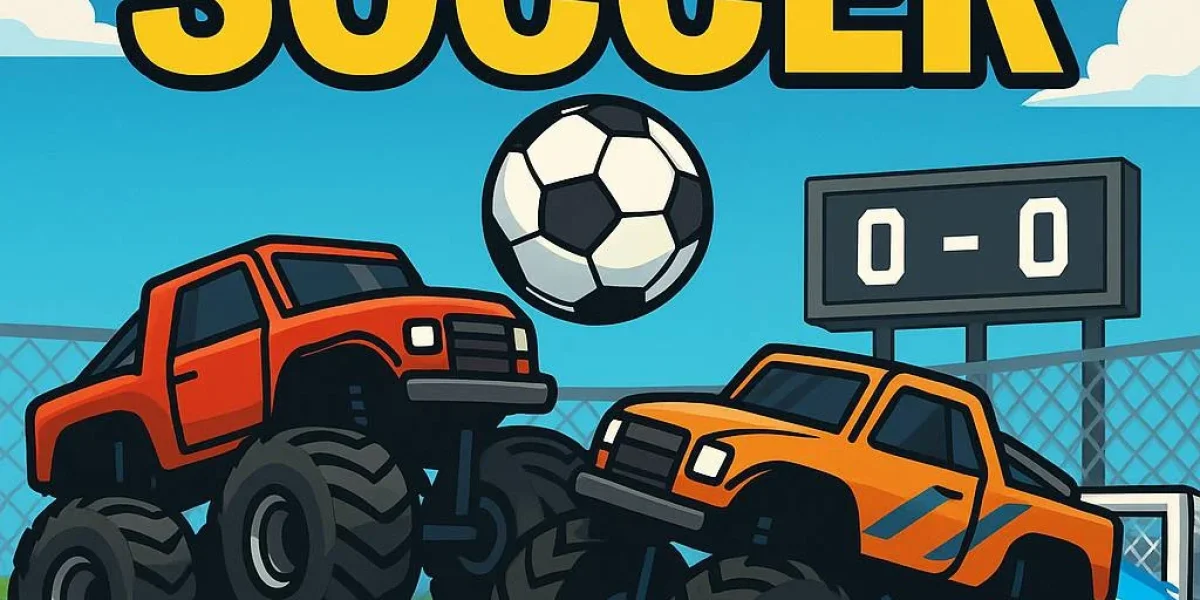
A loose ball above a monster truck is an invitation to make a bad decision. Driving straight underneath it feels active, but often leaves the truck facing away from the next useful touch. Monster Truck Soccer rewards a more deliberate approach: read the ball, choose the side you need to occupy, and make contact with a purpose. This guide explains how to build that approach without assuming that a spectacular collision is automatically a good shot.
You can put the ideas into practice in Monster Truck Soccer. The game combines wheeled movement with a football objective, so driving well and scoring well are related but different skills. A fast truck can still deliver the ball toward its own goal. An apparently modest touch can create a much stronger attacking position than a full-speed impact that sends both truck and ball out of control.
Learn the response before chasing the score
Use the control instructions displayed by the loaded game. Spend your opening exchanges finding out how quickly the truck accelerates, how it changes direction, and how much room you need to correct a mistake. Test each available movement separately. Combining unfamiliar inputs immediately makes it difficult to tell which action caused a bounce, a rotation, or an overshoot. The first useful discovery is a repeatable movement, not an elaborate trick.
Observe the scoreboard and match clock when they are visible. These tell you whether an attempted recovery is helping the actual match objective. Avoid guessing an exact match length or assuming that every stage has identical conditions. The reliable task is to score while protecting your end of the field. Your decisions should reflect the current score and the amount of play remaining, rather than a fixed plan applied to every situation.
Think about the next contact point
Before approaching the ball, imagine a short line from your truck through it. Where would that line send the ball? If it points toward the wrong goal or a position you cannot follow, change your approach. A small adjustment before contact is generally easier to understand than an emergency correction afterwards. This habit also stops the familiar mistake of pushing the ball simply because it is close enough to hit.
The useful side of the ball changes during a rally. When attacking, you usually want to approach from the side that directs it toward the opponent's end. When defending, the immediate priority may be moving it away from danger rather than producing an ambitious counterattack. Treat those as separate decisions. Trying to clear, chase, and score with one uncontrolled impact can turn a manageable defensive situation into a goal against you.
Use distance as a control tool
More run-up can produce a stronger collision, but it also leaves less time to respond if the ball moves. Begin with shorter approaches. Learn what a gentle push does, then compare it with a faster impact from a similar angle. Keep the experiment simple enough that you can remember the difference. You are building a practical sense of contact strength, not looking for one maximum-speed solution to every ball.
Distance matters after the touch too. If the truck ends far beyond the ball, the next action may have to be a retreat rather than another shot. A slightly weaker touch that keeps you near the next useful position can be more effective. Judge the whole exchange: initial approach, collision, landing or recovery, and next available touch. The loudest part of the exchange is not necessarily the part that creates an advantage.
Defend space instead of following every bounce
The ball attracts attention, but the space between the ball and your goal deserves attention as well. If you chase every rebound without considering that space, you can give the opponent an easy route through it. When recovering, first ask whether you can return to a position that blocks a direct threat. Reaching the ball a fraction sooner is not helpful if the resulting contact gives away an open goal.
Do not interpret defensive patience as doing nothing. You are choosing a place from which more than one response remains possible. From a poor angle, rushing can remove those options immediately. From a useful angle, a measured approach lets you react to a bounce, contest the next touch, or clear the ball. Watch the direction of travel and the available room, then commit when the intended result is reasonably clear.
Separate aerial ambition from useful timing
The truck-and-ball physics can create dramatic airborne exchanges. When the game offers a jump or other aerial action, learn its response in isolation before relying on it near your own goal. Watch where the vehicle will come down, not only where it rises. An attempted high interception that leaves you unable to recover can be worse than waiting for a lower, more predictable touch.
Timing should be based on a visible opportunity rather than repeated button pressing. If the ball is already moving away, adding another action may not repair the missed approach. Reset your position instead. This is especially valuable after a failed shot: the next few moments often determine whether the mistake remains harmless or becomes an immediate counterattack. One controlled recovery is usually more instructive than several frantic attempts to undo the same error.
Build an attack in two touches
Imagine the ball is awkwardly positioned near the middle of the field. The first touch does not have to be a shot. It can move the ball into a direction you can follow. The second touch can then become the scoring attempt. This is a planning example, not a guarantee that the opponent will cooperate. Its value is that it gives each action a clear job instead of demanding everything from the first collision.
After the setup touch, reassess. If the opponent reaches the ball first, the original shooting plan may no longer make sense. If the ball rebounds unexpectedly, recover the useful side before accelerating again. Good play is not stubbornly completing a plan that has become obsolete. It is keeping track of what changed and selecting the simplest useful response to the current position.
Recognize three common mistakes
The first mistake is accelerating toward the ball from whichever side is closest. Correct it by checking the intended direction of contact. The second is continuing an attack after the truck has lost a useful angle. Correct it by treating repositioning as part of the attack. The third is trying to recover with multiple unfamiliar inputs at once. Correct it by returning to the most reliable movement you learned during the opening exchanges.
These errors can look like poor reflexes, but their causes are often earlier decisions. If you repeatedly arrive too late, inspect the previous approach. Did you take a longer route than necessary? Did the last touch push the ball too far away? Did you commit before seeing the bounce? Describing one specific cause gives you something to change. Simply deciding to react faster does not.
Adjust to the match situation
When ahead, evaluate whether an ambitious challenge is worth the position it might surrender. When behind, look for a clear chance rather than confusing urgency with constant acceleration. The scoreboard does not change the physics, but it changes the consequences of risk. An uncertain attacking collision can be acceptable in one situation and unnecessary in another. Make that judgment from what the current match actually shows.
If a clock is running down, avoid spending the entire remaining exchange recovering from an overpowered attempt. Give yourself a realistic next action. Equally, do not assume a cautious approach will automatically preserve a lead: you still need to respond to genuine threats. The useful balance is active control with a reason for each commitment, rather than either permanent retreat or permanent pursuit.
Practice one observable improvement
For a short practice session, choose one goal unrelated to the final score. You might focus on approaching from the correct side, staying close enough for a second touch, or recovering between the ball and your goal. Keep that focus for several exchanges. Changing the practice target after every mistake makes progress hard to identify. A narrow target lets you notice whether a particular decision is becoming more consistent.
After the session, recall one exchange that worked and one that failed. Describe the position before the contact, not just whether a goal followed. That creates a reusable lesson: a particular angle was safer, a shorter run-up stayed controllable, or an early retreat prevented a counterattack. Those observations are more valuable than an invented universal rule about how hard every shot should be.
Choose the right kind of next challenge
The Sports Games collection provides other ways to practice aiming, timing, and competition. The relevant comparison is the decision a game asks you to make. A precision shooting puzzle emphasizes selecting a trajectory before the action. Monster Truck Soccer asks you to keep adapting while both the vehicle and ball continue to move. Neither skill replaces the other, even when both games use a football theme.
Return to this game with a clear question you can test. Can you make a useful first touch without losing position? Can you identify when defending space is better than chasing a bounce? Can you recover after a missed attempt without turning it into a second mistake? Answering those questions through repeatable decisions is a stronger foundation than relying on a lucky collision or a dramatic finish.