Solitaire games are single-player card challenges that test patience and planning. The player arranges a deck into specific foundations by moving cards across tableau piles. Common controls involve clicking or dragging to select and move cards to valid slots. These solitaire card games require strategic thinking to clear the board efficiently.
Last Updated:
The Basics: Solitaire games
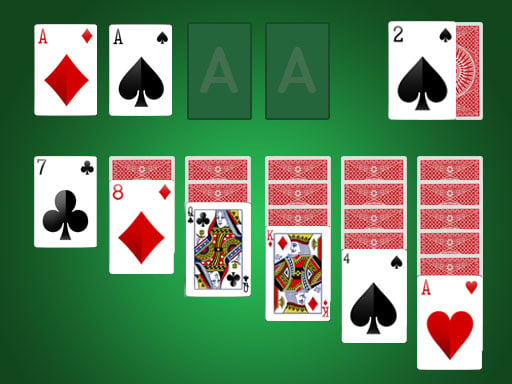
Immediately, the player must sort the shuffled deck into four foundation piles by suit from Ace to King, using the tableau and stock pile for moves.
Gameplay Loop
The core loop involves drawing cards from the stock and placing them onto tableau columns where cards must alternate in color and descending rank order. Players build sequences by moving groups of cards that follow the alternating color and rank rule, revealing hidden cards underneath. The objective is to transfer all cards to the foundations, which is the standard win condition for classic solitaire games and similar klondike solitaire games.
Winning Tactics
Always prioritize revealing face-down cards in the tableau to access more options for building sequences. Remember to plan moves several steps ahead to avoid blocking important cards in the columns. Try to keep tableau columns balanced in length to maintain flexibility for moving card sequences. Use the waste pile strategically by cycling through the stock only when necessary to find specific cards.
Common Questions: Solitaire
Q: What are the typical controls? A: The player typically uses a mouse or touch input to click, drag, and drop cards between piles. Q: What is the main objective? A: The goal is to build four foundation piles in suit from Ace to King using all cards. Q: Is there a timer? A: The presence of a timer is not stated, though many versions track time for scoring. Q: What is the primary mechanic? A: The main mechanic involves moving cards between tableau piles and the stock to reveal and organize them.